
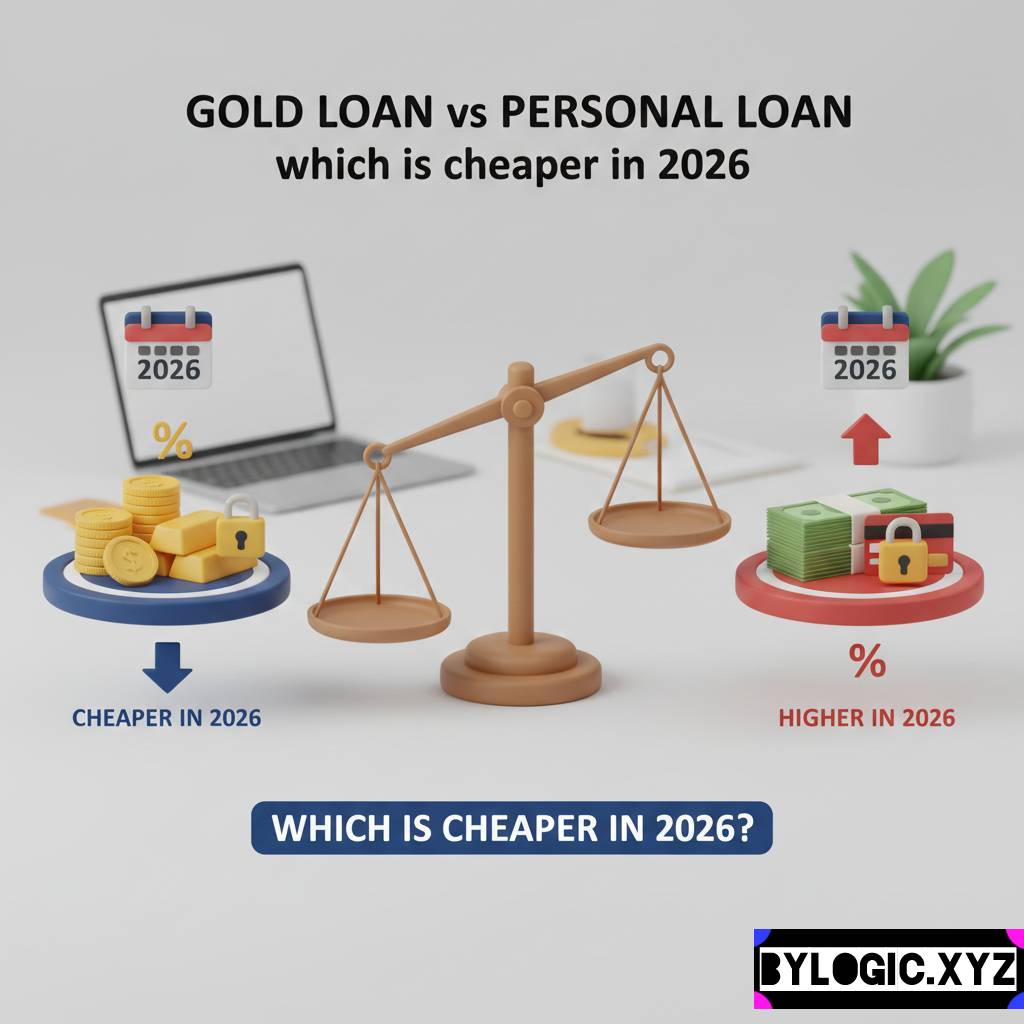
Gold loan vs personal loan: It’s 2026. You need funds fast maybe for a medical emergency, a sudden business opportunity, or perhaps that dream wedding deposit can’t wait. You’re standing at a financial fork in the road: do you walk into the bank and ask for a personal loan based on your salary and credit score, or do you open the locker and pledge the family gold for instant cash?
It’s the classic dilemma. One relies on your reputation (creditworthiness), the other on your assets. But the burning question isn’t just about which is faster; it’s about which one is cheaper right now.
Interest rates have settled a bit since the highs of a few years ago, but lenders are smarter, faster, and more digital than ever. Let’s cut through the banking jargon and look at the real costs.
The Core Difference: Risk vs. Reputation
Before we talk numbers, you need to understand the fundamental difference in how banks view these two loans. This difference is exactly why one is usually cheaper than the other.
Think of it this way:
A Gold Loan is a “secured” loan. You give the bank something valuable (gold jewelry) to hold onto. If you run away to the Himalayas and never pay them back, they can auction your gold to recover their money. Their risk is practically zero. Because the risk is low, they can afford to charge you a lower interest rate.
A Personal Loan is an “unsecured” loan. The bank has nothing of yours to hold. They are lending you money based purely on their trust in you your income, your job stability, and most importantly, your CIBIL score. If you default, they have to chase you through legal means. Their risk is higher. To compensate for that risk, they charge a “risk premium,” which means a higher interest rate.
This fundamental difference is visually represented below. You are essentially weighing your physical assets against your paper credentials.
The 2026 Comparison Table
Let’s look at the raw numbers you are likely to see in the market today.
| Feature | Gold Loan | Personal Loan |
| Interest Rate (Approx.) | 8.5% – 16% p.a. | 10.5% – 24% p.a. |
| Basis of Approval | Value of Gold Pledge | Credit Score (CIBIL) & Income |
| Processing Speed | 30 mins to 4 hours | Instant (Pre-approved) to 3 Days |
| Processing Fees | Usually lower (₹500 – 1% of loan) | Usually higher (1% – 3% of loan) |
| Credit Score Impact | Doesn’t matter for approval | Crucial. Low score = High rate/Rejection |
| Foreclosure Charges | Often NIL after a lock-in period | Usually high (2% – 5% of outstanding principal) |
My Commentary:
As you can see, the starting interest rates for gold loans are significantly lower. If you have a fantastic credit score (say, 800+), you might get a personal loan rate that rivals a mid-range gold loan rate. But for the average person, the gold loan wins on pure interest percentage.
Furthermore, personal loans often have higher processing fees that are deducted from the loan amount itself. And the biggest trap? Foreclosure charges. If you come into some money six months later and want to close your personal loan, the bank will often hit you with a hefty penalty. Gold loans are much friendlier in this regard; many lenders allow you to close the loan without penalty after just a few months.
Real-Life Scenario: The Emergency Fund
Let’s take Ramesh. He needs ₹3 lakhs urgently for a family medical situation. He has a decent job but his credit score is average (around 730) because he missed a couple of credit card payments last year. He also has his mother’s old gold jewelry sitting in a bank locker.
YOU CAN ALSO READ:
How repo rate changes affect your EMIs: Useful guideOption A: Personal Loan Ramesh applies online. Because his score isn’t top-tier, the bank offers him a rate of 14.5%. The processing fee is 2% (₹6,000). He takes it for 3 years.
- Total Interest Payable: Approx ₹72,000
- Total Cost (Interest + Fees): Approx ₹78,000
Option B: Gold Loan Ramesh takes the jewelry to a reputable NBFC or bank. They appraise it and offer him a loan at 9.5%. The processing fee is a flat ₹1,000. He plans to pay it back in a year by selling some other investments.
- Total Interest Payable (for 1 year): Approx ₹28,500
- Total Cost (Interest + Fees): Approx ₹29,500
The Verdict: In this very common scenario, the gold loan is vastly cheaper. Even if Ramesh kept the gold loan for 3 years, the total interest would be around ₹85,500. It still competes well with the personal loan, especially when you factor in the lower processing fee and the flexibility to close it early without penalty.
However, the experience of getting these loans is vastly different, as shown below. One requires a physical visit with assets, the other can often be done from your sofa.
The “Emotional Cost” Factor
We can’t just talk about money. There’s a reason people hesitate with gold loans. It’s emotional. That jewelry might be your grandmother’s wedding set. The thought of handing it over to a stranger behind a counter is terrifying. What if the bank gets robbed? What if you can’t pay it back and they auction it?
This emotional “cost” is real. If the anxiety of pledging your gold is going to keep you up at night, then a slightly more expensive personal loan might be worth the peace of mind.
On the flip side, a personal loan has its own stress. It’s a monthly EMI obligation that hangs over your head for years. Missing a payment can ruin your credit score for a long time, making future borrowing even harder.
How to Decide: A Simple Checklist
Still confused? Here is a practical way to make the decision.
- Check Your Credit Score: This is step one. If your CIBIL is below 750, stop right there. A personal loan will be very expensive for you. The gold loan is your best bet.
- Calculate the LTV (Loan to Value): How much gold do you have? Banks will typically lend you up to 75% of the gold’s current market value. If you need ₹5 lakhs but only have ₹3 lakhs worth of gold, a gold loan won’t cover your need.
- Define the Tenure: Do you need the money for 6 months or 5 years? Gold loans are best for short-term needs (up to 1-2 years). For longer tenures, a personal loan provides a structured EMI plan that might be easier to manage.
- Read the Fine Print on Repayment: Gold loans offer different repayment structures. Some let you pay only interest monthly and the principal at the end (Bullet Repayment). Others work like a standard EMI. Make sure you choose the one that fits your cash flow.
- Assess Your Discipline: Be honest with yourself. If you take a gold loan with a bullet repayment option, will you actually save up the principal to pay it back at the end of the year? Or will you spend that money and be stuck renewing the loan, paying interest forever? If you lack that discipline, the forced savings of a personal loan EMI might be safer.
Final Verdict for 2026
If we are talking purely about the cost of borrowing the interest rate, the fees, and the flexibility the gold loan is almost always cheaper. It’s a simple function of risk; secured loans are just less risky for banks.
In 2026, with digital processes making gold loan disbursements faster than ever, the convenience gap has narrowed. The stigma around pledging gold is also fading. It’s seen more as a smart way to leverage a dead asset.
My advice? If you have the gold, can overcome the emotional hurdle, and need money for a short-to-medium term, go for the gold loan. It’s the financially savvier choice. Save the personal loan option for when you don’t have assets to pledge, or when you need a very long repayment period and have an excellent credit score to command the best rates.
YOU CAN ALSO READ:
Home loan vs rent: complete cost comparison for 20 yearsDisclaimer: Please consult your financial advisor before taking any financial decision regarding loan or prepayments.
Explore more categories:
https://bylogic.xyz/category/digital-payments-banking-and-personal-finance-tools/
https://bylogic.xyz/category/insurance-life-and-health/