
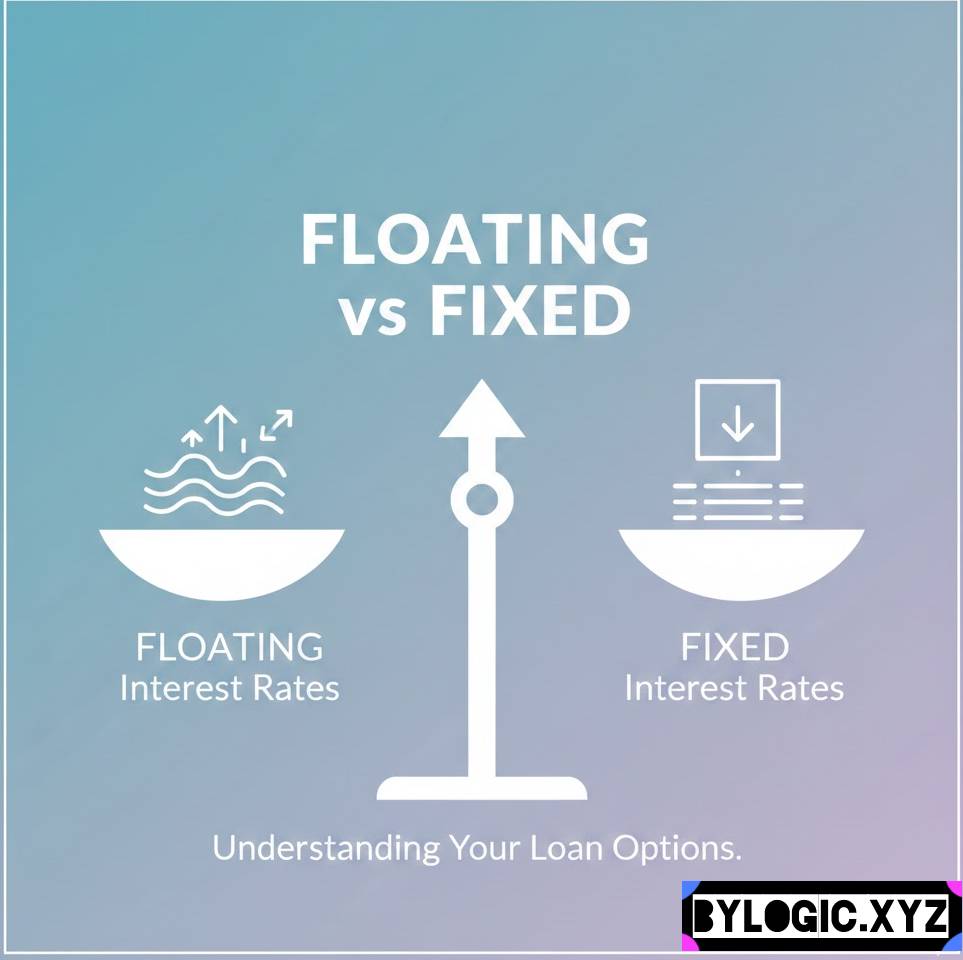
Okay, let’s talk about Floating vs fixed interest rates which can save you a ton of money or give you sleepless nights: interest rates. Specifically, whether you should go for a floating rate or a fixed rate on your loans, especially here in India. It’s not a one-size-fits-all answer, no matter what some bank agent might tell you. It truly depends on a mix of economic winds, your personal risk appetite, and what you’re planning to do with that loan.
Imagine you’re standing at a fork in the road. One path is smooth, predictable, and goes exactly where you expect. The other path twists and turns, sometimes it’s uphill, sometimes downhill, but it might get you there faster or with a more scenic view. That’s essentially fixed vs. floating rates. Let’s break it down, because understanding this can genuinely change your financial game.
YOU CAN ALSO READ:
How inflation quietly eats guaranteed returns : FDs, RDs, savings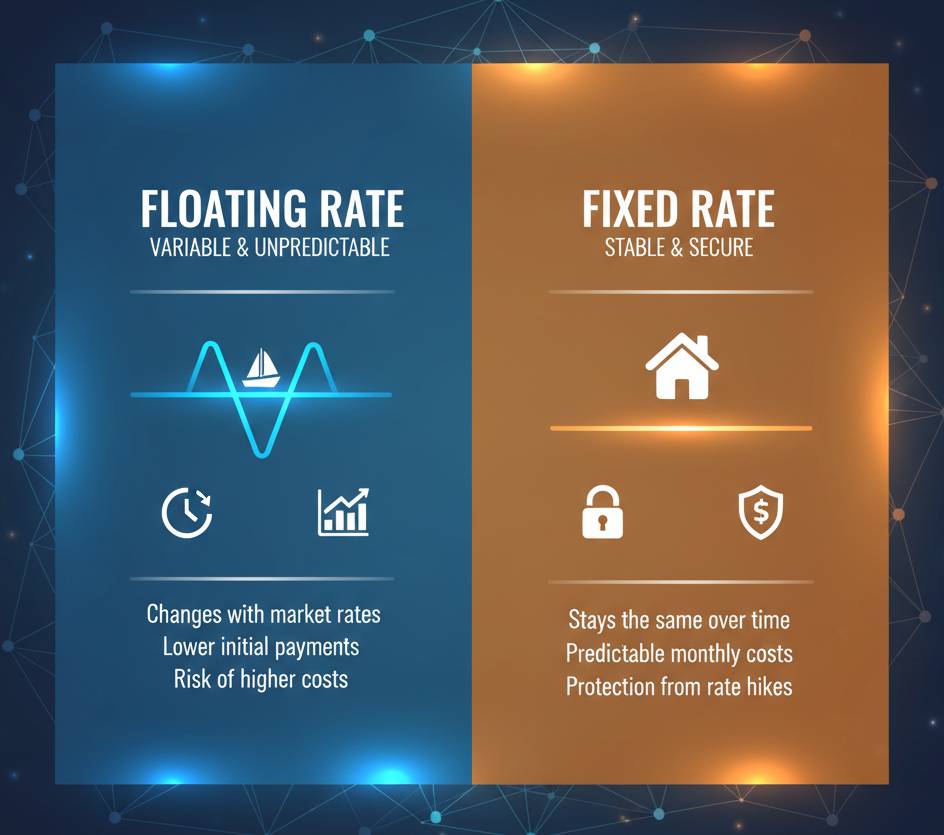
The Predictable Comfort of a Fixed Rate
Think of a fixed interest rate like a promise. The bank promises you a certain interest rate for the entire tenure of your loan, come rain or shine, inflation or deflation. Your EMI (Equated Monthly Installment) remains constant. Period.
When does this make sense?
- When Interest Rates Are Low (Historically Low, Even): This is the golden rule for fixed rates. If you see interest rates dipping to levels that make you think, “Wow, this is cheap money,” that’s your cue. Lock it in! If you took a home loan at, say, 7% fixed when rates were generally higher, you’d be patting yourself on the back if they then shot up to 9% or 10%. You’re insulated.
- For Budgeting Gurus: Are you someone who plans every rupee, every month? Do you hate surprises when it comes to your outgoings? Then a fixed rate is your best friend. You know exactly what you’re paying, and that helps you manage your household budget, investments, and other expenses without any sudden jolts. No mid-month panic about EMIs going up.
- During Periods of Expected Rate Hikes: If the Reserve Bank of India (RBI) is signaling that they’re likely to increase repo rates (which directly impacts lending rates) in the near future, moving to a fixed rate can be a smart defensive play. It’s like putting on a warm jacket when you know a cold front is coming.
- Long-Term Loans (Especially Home Loans): For a 15-20 year home loan, a fixed rate provides immense stability.Imagine the mental peace of knowing your biggest monthly expense won’t fluctuate for two decades. This stability can be invaluable, especially for young families or those planning long-term financial goals.
My Two Cents on Fixed Rates: Honestly, if I were taking a long-term loan and the rates were attractive, I’d lean heavily towards fixed. The peace of mind alone is worth a slight premium sometimes. We’ve seen cycles where rates shot up dramatically, and those on fixed rates were laughing all the way to the bank (to pay their stable EMI, that is!).
The Dynamic Dance of a Floating Rate: Floating vs fixed interest rates
A floating interest rate, on the other hand, is like riding the waves. Your interest rate isn’t set in stone; it fluctuates based on a benchmark rate (like the RBI’s repo rate, or MCLR for older loans). If the benchmark goes up, your interest rate goes up, and so does your EMI or the loan tenure. If it goes down, you benefit.
When does this make sense?
- When Interest Rates Are High (and Expected to Fall): This is the flip side of the fixed rate coin. If you’re taking a loan when interest rates are historically high and you expect the RBI to cut rates soon, a floating rate is your ticket to savings. As rates fall, your EMI will decrease, or your loan tenure will shorten.
- For Shorter-Term Loans: For personal loans, car loans, or other loans with shorter tenures (say, 3-5 years), the impact of rate fluctuations might be less significant compared to a 20-year home loan. The chances of drastic,sustained rate movements over a short period are generally lower, making floating rates a viable option.
- If You Have a High-Risk Appetite & Financial Buffer: If you’re comfortable with a bit of unpredictability and have enough financial wiggle room to absorb potential EMI hikes, then floating rates can work. You’re essentially betting on interest rates moving in your favour or staying stable.
- When the Economy is Stable/Deflationary: In an economy where inflation is under control and there’s no immediate pressure for the central bank to hike rates, floating rates might offer a slight edge due to generally lower initial rates compared to fixed rates.
My Two Cents on Floating Rates: Floating rates can be a double-edged sword. When rates are falling, it feels great!You’re saving money. But when they start climbing, it can pinch, especially if you haven’t factored in higher EMIs into your budget. It requires a bit more active monitoring and sometimes, a bit of prayer!
How to Decide: The Nitty-Gritty
It’s not just about looking at today’s rates. It’s about foresight.
YOU CAN ALSO READ:
Credit score improvement plan : Useful Practical Guide1. Current Economic Environment:
- High Inflation? RBI is likely to raise rates to curb it. Fixed might be safer.
- Low Inflation/Economic Slowdown? RBI might cut rates to stimulate growth. Floating might be beneficial.
2. Your Personal Financial Situation:
- Stable Income, Tight Budget? Fixed offers certainty.
- Flexible Income, Emergency Fund? Floating could offer savings if rates fall, and you can absorb hikes.
3. Loan Tenure:
- Long-Term (10+ years)? Fixed offers long-term stability.
- Short-Term (under 5 years)? Floating might be less risky, as market cycles might not complete within that short period.
4. The Spread: Sometimes, banks offer a fixed rate that’s significantly higher than the current floating rate. You need to weigh if that premium for stability is worth it. Conversely, if the fixed rate is only slightly higher, it might be a no-brainer.
Practical Tips & Common Misconceptions
- Don’t just look at the starting rate: A floating rate might start lower, but don’t let that be the only deciding factor.Calculate potential EMI increases if rates go up by 1% or 2%. Can you still afford it comfortably?
- Read the fine print: Banks often have clauses allowing them to revise fixed rates after a few years or convert floating to fixed (and vice versa) with a fee. Understand these terms.
- Conversion Option: Most banks offer the option to convert from floating to fixed, or fixed to floating, usually for a small fee. This gives you flexibility. If you’re on a floating rate and see rates climbing, you might convert to fixed.Or if you’re fixed and rates are plummeting, you might switch to floating. This flexibility is gold.
- Impact of prepayment: With a floating rate, prepaying your loan reduces the principal faster, and subsequent rate changes apply to a smaller outstanding amount. This is a powerful tool to manage floating rate risk.
A Real-Life Style Example (Because Numbers Speak Louder)
Let’s say Rohan took a ₹50 lakh home loan for 20 years.
- Scenario A (Fixed Rate): He locked in at 8.0% fixed. His EMI is ₹41,822. Even if market rates shoot up to 10%,his EMI remains ₹41,822. He sleeps soundly.
- Scenario B (Floating Rate): He took it at 7.75% floating. His initial EMI is ₹40,897. A year later, the RBI hikes rates, and his rate jumps to 9.0%. His EMI then rises to ₹44,989 (or his tenure extends). That’s an extra ₹4,092 a month out of his pocket. But, if rates had fallen to 7.0%, his EMI would drop to ₹38,765, saving him ₹2,132 a month.
See the difference? It’s not trivial.
How to Approach Your Bank
When you walk into the bank, don’t just ask “What’s your best rate?” Ask about both fixed and floating options.
- Ask for the current fixed rate and the current floating rate.
- Inquire about the benchmark: Is it Repo-Linked Lending Rate (RLLR) or Marginal Cost of Funds Based Lending Rate (MCLR)? RLLR is generally more transparent and directly linked to RBI’s repo rate.
- What are the conversion charges? This is crucial for future flexibility.
- Are there any special offers for balance transfers? Sometimes, switching your loan to another bank can get you a better deal.
Conclusion
Choosing between a floating and fixed interest rate isn’t about choosing the “better” option universally. It’s about choosing the right option for you, at this specific point in time. It’s a strategic decision that needs a bit of homework and a peek into what financial pundits are predicting. Don’t let anyone push you into a decision you’re not comfortable with.
YOU CAN ALSO READ:
Retirement planning for people without PF or pension: Useful guideBefore making any significant financial decisions, especially concerning loans and interest rates, You should consult your financial advisor before taking any financial decision. They can provide personalized advice based on your specific situation and market outlook.
Explore more categories:
https://bylogic.xyz/category/investing-and-wealth-building/
https://bylogic.xyz/category/loans-and-credit/