
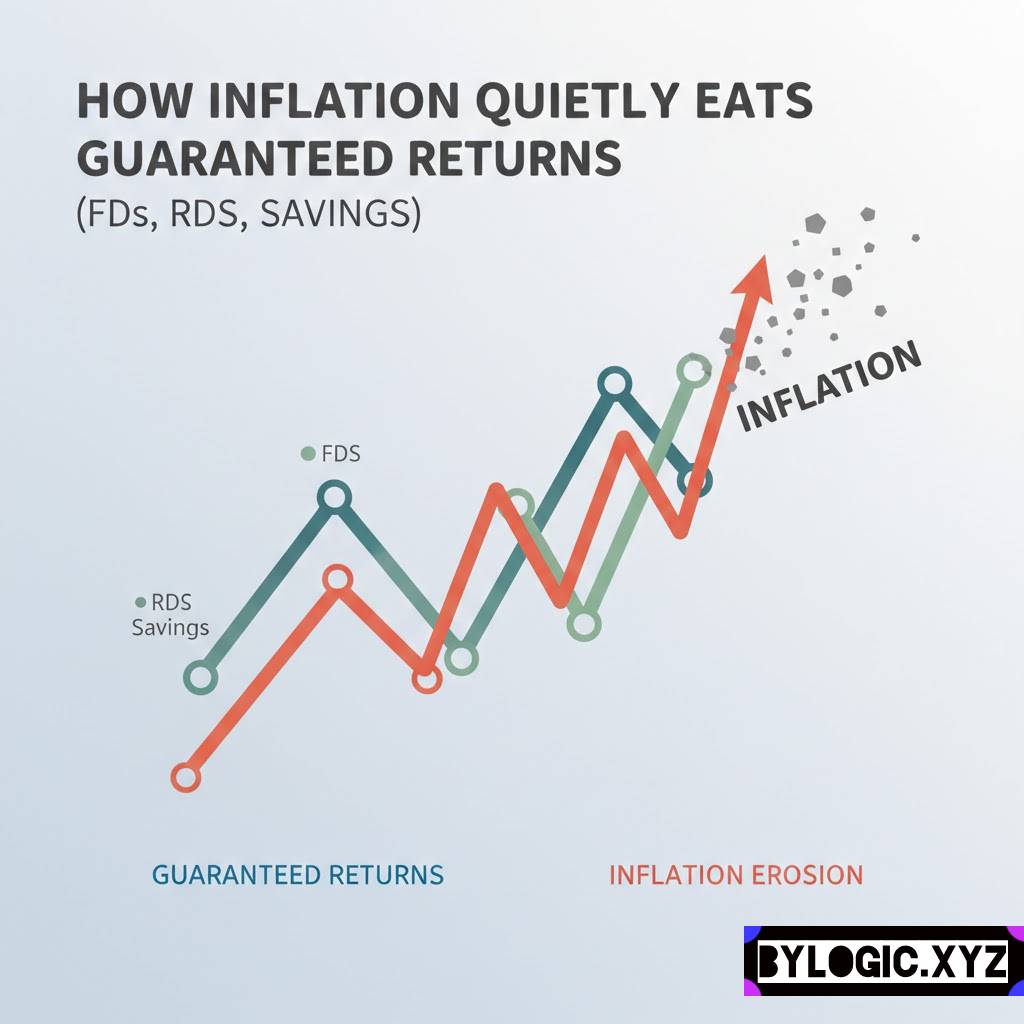
Many people don’t even have idea, How inflation quietly eats guaranteed returns. Have you ever looked at your bank passbook or logged into your net banking app, seen the interest credited to your Fixed Deposit (FD), and felt a small sense of achievement? It’s a very Indian feeling. We love the “guarantee.” We love knowing that if we put in ₹1 lakh today, we’ll get exactly ₹1.4 or ₹1.5 lakh back after a few years. It’s the ultimate sleep-at-night investment.
But there’s a quiet, invisible thief sitting right inside your bank account. It doesn’t send a notification. It doesn’t show up as a debit entry. Yet, it’s constantly shaving off the value of your hard-earned money. That thief is inflation.
YOU CAN ALSO READ:
Personal loan rejection reasons banks never explainThe Illusion of the “Safe” Return
Most of us were raised with the idea that “Risk = Losing Money.” Therefore, putting money in a savings account or an FD is “Risk-Free.” But we need to redefine what risk actually means. Is risk only about the principal amount going down? Or is risk also about the purchasing power of that money disappearing over time?
Let’s look at a real-life scenario. Imagine it’s the year 2014. You have ₹50,000. Back then, that could buy you a pretty decent high-end smartphone or maybe a good chunk of a down payment for a two-wheeler. You decide to be “safe” and put it in an FD for 10 years at a 7% interest rate.
Fast forward to 2024. Your ₹50,000 has grown to roughly ₹1,00,000 (doubled, thanks to compounding). You feel like a genius. But then you go to the market. That same category of smartphone now costs ₹80,000. The two-wheeler that cost ₹60,000 then now costs ₹1.2 lakh.
Even though your money numerically increased, your ability to buy things with it actually stayed the same or, in many cases, decreased. This is the “Guarantee” trap. You were guaranteed the amount, but you weren’t guaranteed the value.
The Math We Often Ignore: Real Rate of Return
To understand how inflation eats your returns, you have to look at the Real Rate of Return. It’s a simple formula, but banks won’t show it to you on their flashy banners:
Real Return = Nominal Interest Rate – Inflation – Taxes
Let’s break this down with current numbers. Suppose you have an FD giving you 7% interest.
- Inflation: In India, consumer inflation usually hovers around 5% to 6%. Let’s be optimistic and say it’s 5.5%.
- Taxes: If you are in the 20% or 30% tax bracket, the government takes a bite out of that 7% interest before you even see it. At a 30% slab, your 7% interest effectively becomes 4.9%.
Now do the math: 4.9% (Post-tax return) – 5.5% (Inflation) = -0.6%.
You aren’t making money. You are literally paying the bank to keep your money while its value shrinks. You are becoming poorer, just very slowly and very safely. Please consult your financial advisor before taking any financial decision regarding shifting your core savings.
Why “Guaranteed” Returns Feel So Good (The Psychology)
We aren’t rational beings; we are emotional ones. The reason FDs and RDs (Recurring Deposits) remain the most popular investment in middle-class households isn’t because they are the best it’s because they are the most certain.
There is a psychological comfort in seeing a fixed number. The stock market fluctuates. Gold prices swing. But an FD? That number only goes up. It’s a “linear” growth. Our brains love linearity. We hate the “zig-zag” of equity, even if the zig-zag ends up much higher than the straight line of an FD.
I remember talking to an uncle who insisted that his 6% Savings Account was better than any mutual fund because “the bank won’t run away.” He wasn’t wrong about the bank staying put, but he was missing the point that while the bank stayed still, the price of milk, petrol, and school fees moved miles ahead of him.
YOU CAN ALSO READ:
10 Silent Money Mistakes Destroying Your Future Wealth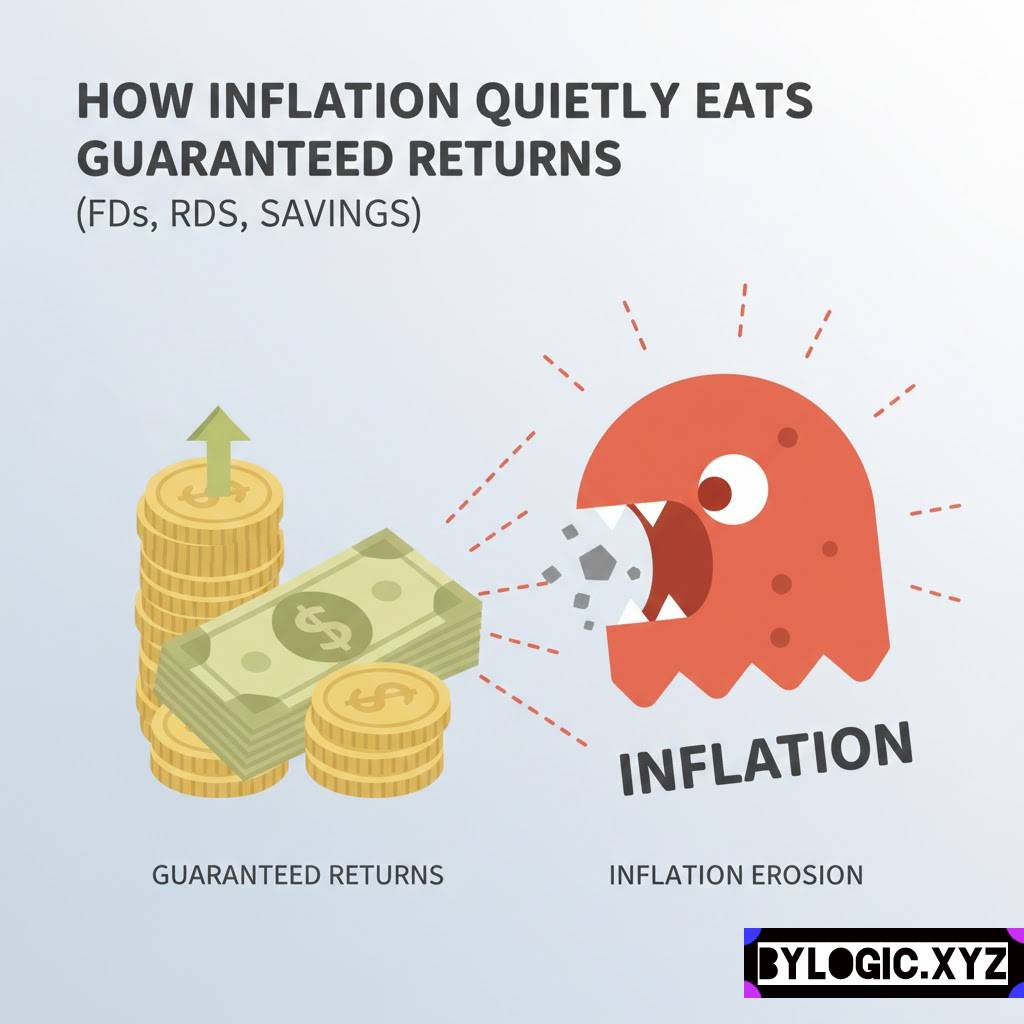
The “Lifestyle Inflation” Factor
Usually, when we talk about inflation, we look at the government’s CPI (Consumer Price Index). But “Personal Inflation” is often much higher. CPI includes things like the price of wheat and kerosene. But your life includes gym memberships, OTT subscriptions, dining out, and gadgets.
If your personal expenses are rising at 8-10% a year, and your “guaranteed” investment is giving you 6% after tax, you are facing a massive deficit. This is why many people who retire with what they thought was a “huge corpus” of FDs find themselves struggling after 10 years of retirement. They didn’t account for the fact that a cup of coffee that costs ₹20 today might cost ₹100 by the time they are halfway through retirement.
How to Protect Your Wealth (The Practical Way)
You don’t have to abandon FDs entirely. They have their place especially for emergency funds or money you need in the next 12 months. But for long-term wealth? You need to fight back.
1. The 60-40 or 70-30 Rule
Don’t put all your eggs in the “guaranteed” basket. A common strategy is to keep enough in FDs/Liquid funds for emergencies (6-12 months of expenses) and move the rest into inflation-beating assets like Equity Mutual Funds or Index Funds. Over 10+ years, equity has historically outperformed inflation by a wide margin.
2. Look at Tax-Efficient Options
If you are in a high tax bracket, FDs are particularly brutal. Explore options like the Public Provident Fund (PPF) or Debt Mutual Funds (though tax laws here have changed, they can still be strategic). For many, the Equity Linked Savings Scheme (ELSS) provides a way to grow money while saving tax.
3. Don’t Just Save, Invest
Saving is keeping money aside. Investing is putting that money to work. If your money isn’t growing faster than the cost of living, it’s just “parking.”
4. Review Your “Real” Returns Yearly
Once a year, sit down and look at your portfolio. Don’t just look at the percentage the bank gave you. Subtract the current inflation rate and your tax liability. If that number is negative or zero, it’s time to rethink your strategy.
Common Myths vs. Reality
| Myth | Reality |
| FDs are risk-free. | FDs have “Purchasing Power Risk.” You won’t lose the amount, but you lose what that amount can buy. |
| I’ll invest when the market is “stable.” | Inflation is never “unstable” it’s always there, eating your money. Waiting for a perfect market while sitting in a 3% savings account is a guaranteed loss. |
| Gold is the only hedge. | Gold is a good hedge, but it doesn’t generate “yield” (interest/dividends). It’s a store of value, not necessarily a wealth creator like a business or an index fund. |
How to Transition from “Saver” to “Investor”
If you’ve lived your whole life believing in the sanctity of the FD, moving to other assets can feel scary. It’s like jumping into a pool when you’ve only ever stood in the shower. Here is a step-by-step way to do it without losing sleep:
- The Emergency Bucket: Keep 6 months of your expenses in a high-interest savings account or a short-term FD. This is your “peace of mind” money. Don’t worry about inflation here; worry about liquidity.
- The SIP Route: Don’t move all your money at once. Start a Systematic Investment Plan (SIP) in a simple Nifty 50 Index Fund. It’s boring, it’s simple, and it represents the top 50 companies in India.
- The “Lollipop” Method: Whenever an FD matures, don’t just renew the whole thing. Take 20% of the maturity amount and put it into a diversified mutual fund. Keep the other 80% in an FD if it makes you feel safe. Slowly, as you see the 20% grow over the years, your confidence will increase.
- Educate Yourself: Read about how compounding works when the rate of return is even 2% higher than inflation. That 2% gap over 20 years is the difference between an average retirement and a wealthy one.
Final Thoughts: The Cost of “Safety”
The hardest thing to accept is that “safe” investments can be the riskiest ones in the long run. If you are 30 years old today and you keep all your money in RDs and FDs, you are almost certainly guaranteeing a struggle-filled 60s.
Inflation isn’t a monster that attacks suddenly; it’s a slow erosion. It’s the reason why a movie ticket that cost ₹50 in our childhood now costs ₹500. It’s the reason why “Lakhpati” used to be a big title, but today, having a lakh in the bank is just a basic safety net.
Don’t let the comfort of a “guaranteed” percentage blind you to the reality of your shrinking wealth. Be brave enough to diversify, be patient enough to handle market swings, and always, always keep an eye on the realvalue of your money.
Safety is good, but growth is what pays the bills twenty years from now.
What’s your “inflation realization” story? Was it the price of a gas cylinder or the cost of a plate of momos that finally made you realize your savings aren’t keeping up? Sometimes, the best financial lessons aren’t found in books, but in our monthly grocery bills.
YOU CAN ALSO READ:
How to build a good portfolio without high riskAgain, Please consult your financial advisor before taking any financial decision, especially if you are nearing retirement or have specific liability needs.
Explore more categories:
https://bylogic.xyz/category/investing-and-wealth-building/
https://bylogic.xyz/category/loans-and-credit/